
Villa Management in Bali After Handover
You received the keys to a villa in Bali, and now someone has to run it while you live thousands of kilometres away.
 KAMRITA team10 min read ·
 Enlarge image
Contents10 sections
- What Is Villa Management in Bali?
- What a Villa Management Company Does
- Villa Management Costs and Fees in Bali
- What Can Your Bali Villa Earn?
- How to Choose a Villa Management Company in Bali
- From Handover to First Guests: Getting Your Villa Operational
- Our Experience: Green Harmony Case and Guest Ratings
- Frequently Asked Questions
- The Short Version
- Next step
You received the keys to a villa in Bali, and now someone has to run it while you live thousands of kilometres away. This guide explains how villa management in Bali works after handover: what a Management companyThe company that runs a villa as a rental after handover: bookings, guests, cleaning, maintenance and the monthly owner report. It is paid a share of revenue. actually does, how its fees are built, what your villa can realistically earn, and how to tell a reliable local team from a glossy sales pitch — so you can judge the people who will run your property, not just the brochure.
What Is Villa Management in Bali?
Villa management in Bali is the outsourced operation of a privately owned villa after handover — bookings, guest services, housekeeping, maintenance and financial reporting handled by a professional company so an absent owner does not have to run the property day to day. It turns a finished building into a working rental, and it is the layer that stands between you and every guest who sleeps in your villa.
The owner stays the owner and keeps the income. The management company becomes the operator: it lists the villa, prices the nights, answers guests, cleans between stays, fixes what breaks and sends you a monthly statement. For a remote buyer in Ubud this is the difference between a property that earns and one that sits empty because nobody is on the ground to open the gate. Property management here usually means short-stay rental through OTA listings rather than a single long lease, which is why guest turnover, reviews and an on-site team matter so much.
 Enlarge image
What a Villa Management Company Does
A full-service manager typically covers OTA listing and marketing, guest communication, check-in and check-out, housekeeping, maintenance and monthly financial reporting. These are the recurring jobs that keep a villa occupied, clean and accounted for, and most contracts bundle them under one management fee.
Here is what sits inside each of those jobs:
- Marketing and OTA listings. The manager creates and runs your listing on Booking.com, Airbnb and similar platforms, writes the copy, sets the photos and adjusts nightly pricing by season and demand.
- Guest communication and concierge service. Enquiries, booking confirmations, airport-transfer requests, restaurant tips and problem-solving during the stay land with the manager, not with you at 3 a.m.
- Check-in and check-out. An on-site team meets guests, hands over keys, inspects the villa on departure and resets it for the next arrival.
- Housekeeping. Cleaning between stays, linen, pool upkeep and garden care keep the villa at the standard guests paid for.
- Maintenance. Routine checks plus repairs — air-conditioning, plumbing, electrics — handled before a small fault becomes a bad review.
- Financial reporting. A monthly statement shows gross revenue, every deduction and the net income paid to you.
The practical test of a manager is whether all of this runs without you chasing it. If you are forwarding guest messages yourself or asking where last month's figures are, you are doing part of the job you paid them to do.
 Enlarge image
Villa Management Costs and Fees in Bali
Villa management costs are built from a recurring management fee plus pass-through expenses, so the headline percentage is never the whole price. Compare managers on the total cost to you, not on the commission line alone — a low fee with vague extras can cost more than a higher fee that covers them.
The cost components you should map before signing:
- Management fee. A percentage of rental revenue that pays for marketing, guest handling and operations. This is the figure companies quote first.
- Onboarding and marketing setup. One-off work to furnish-check, photograph, write and launch the listing. Sometimes included, sometimes billed separately — ask which.
- Utilities. Electricity, water, internet and gas scale with OccupancyThe share of nights a villa is booked over a period. Green Harmony: 88.1% on average, January–July 2025. Past results, not a forecast. and are usually passed through to the owner.
- Maintenance and upkeep. Pool chemicals, garden, minor repairs and consumables. Clarify what is routine (inside the fee) and what is billed on top.
Method: request a sample monthly statement and ask the manager to list every fee and every pass-through charge in writing. What good looks like: you can forecast net income for a typical month from that single document, with no "miscellaneous" line you cannot explain. Where this breaks down: the first months after launch carry onboarding costs and thin occupancy, so early statements will understate a steady-state month — read them as ramp-up, not as the norm.
 Enlarge image
What Can Your Bali Villa Earn?
Estimate returns from occupancy, average nightly rate and net margin after the management fee and taxes, using conservative assumptions rather than peak-season figures. Model low, medium and high occupancy against a realistic nightly rate, subtract all fees and taxes, and you end up with a net-income range instead of one optimistic number a salesperson would rather show you.
Here is an illustrative estimate. Every input below is an assumption for the sake of arithmetic, not a quote and not market data:
- assume an average nightly rate of $160
- assume occupancy scenarios of 50% (low), 65% (medium) and 80% (high)
- assume all fees and taxes together take 30% of gross revenue
- assume 30 nights in the month
The maths, scenario by scenario:
- Low gross: $160 × 0.50 × 30 = $2,400; net: $2,400 × 0.70 = $1,680
- Medium gross: $160 × 0.65 × 30 = $3,120; net: $3,120 × 0.70 = $2,184
- High gross: $160 × 0.80 × 30 = $3,840; net: $3,840 × 0.70 = $2,688
Swap in your own nightly rate and the fee structure your manager actually quotes, and the method holds. The point is the spread: a villa does not earn its high-season peak twelve months a year, so planning on the medium line keeps you honest.
Actual returns depend on location, villa quality, how well the listing is marketed and the ramp-up period before occupancy settles. Treat any single "expected yield" number — especially a high one offered before you have seen a real statement — as a claim to verify, not a figure to bank on.
 Enlarge image
 Enlarge image
How to Choose a Villa Management Company in Bali
Choose a manager with a verifiable local track record — real guest ratings, transparent reporting and on-site teams — over the one quoting the highest promised yield. A number on a slide costs nothing to print; a live 9-something score across dozens of recent stays is hard to fake.
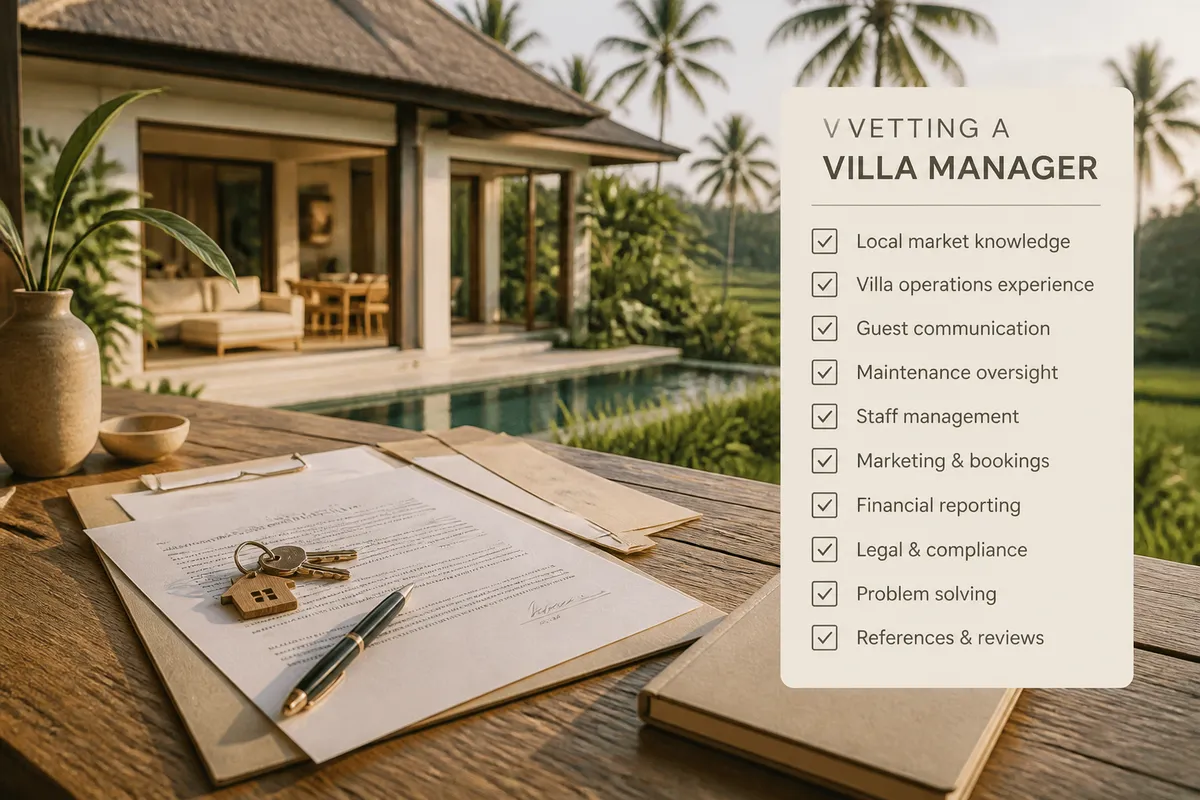
Vet candidates against these criteria:
- Verifiable ratings. Find the company's managed villas on Booking.com and Google and read the live scores and recent reviews yourself.
- Transparent reporting. They show you a real sample statement with every line itemised, before you sign.
- On-site team. Real people in the area who can reach your villa the same day, not a remote call centre.
- Responsiveness. How fast they reply to you now is a fair preview of how fast they will reply to a guest.
- Honest numbers. Ranges and conditions beat a single guaranteed figure — anyone promising a fixed income is selling, not forecasting.
Method: open the live listings, check the current ratings, read the latest guest reviews and ask for the sample statement. What good looks like: consistent high scores across many stays and prompt, specific answers to your questions. Where this breaks down: a strong past record does not guarantee identical results for your specific villa, location and season — it raises the odds, it does not remove the risk.
Suppose two managers quote you. One promises a headline return and shows no public listings; the other quotes a cautious range and points you to villas you can check on Booking.com tonight. The second is the safer bet, even if the first number looks nicer, because you can confirm it before you commit.
 Enlarge image
From Handover to First Guests: Getting Your Villa Operational
Expect a gap between receiving the keys and taking the first booking. Furnishing, professional photos, permits and OTA listing setup all happen before a guest can book, so income starts after your villa is ready, not on handover day. No rental income accrues before the villa is handed over and operational — a building without furniture, photos and a live listing earns nothing.
A realistic sequence from handover to first guest:
- Furnish and stage. Fit out the villa to the standard your nightly rate implies — beds, kitchen, outdoor space — because guests rate what they actually experience.
- Professional photos. Good photography drives the click on an OTA listing; shoot the villa once it is fully staged.
- Permits and licensing. Put the rental paperwork in order so the listing is compliant from the first night.
- Build the OTA listings. Write the copy, set pricing and publish on Booking.com, Airbnb and the platforms your manager uses.
- Open the calendar and launch. Go live, take the first bookings and let early reviews start building your score.
Method: sequence furnishing, photos, licensing and listing against a target launch date and work backwards. What good looks like: listings are live and accepting bookings on the day you planned. Where this breaks down: permit timelines and high-season cut-offs can push the launch later than you hoped, so leave slack rather than promising yourself a specific first-booking week.
 Enlarge image
Our Experience: Green Harmony Case and Guest Ratings
Our completed Green Harmony villas in Pejeng (Ubud) — four one-bedroom villas with a study — sold out 4 of 4 off renders in 2023 and were handed over in October 2024. That is a finished, delivered project you can look up, not a render on a pitch deck.
The operating result shows up where guests leave it. On Booking.com the handed-over Green Harmony villa holds a 9.0 "Superb" guest score from 12 reviews, as of October 2026. A rating like that is live and it moves with every stay, which is the point — you can open the listing and check it today instead of trusting a figure on a slide.
 Enlarge image
 Enlarge image
Access to the team matters as much as the track record when you are buying and running remotely. Our sales managers reply on WhatsApp and Telegram within 15 minutes, Bali time (GMT+8). The speed you get as a prospective owner is a fair preview of the attention a guest in your villa will receive.
 Enlarge image
Frequently Asked Questions
What does villa management in Bali actually cover? It covers the full operation of your villa after handover: marketing and OTA listings, guest communication, check-in and check-out, housekeeping, maintenance and monthly financial reporting. In practice the manager runs everything a guest touches and sends you the income and the statement. You stay the owner; they do the day-to-day.
How much does villa management cost? The main line is a management fee charged as a percentage of rental revenue, plus pass-through costs such as utilities, maintenance and the tourist tax, and sometimes a one-off onboarding and marketing charge. Compare the total cost, not just the headline percentage. Ask for a sample monthly statement so every charge is visible before you sign.
What can my villa realistically earn? Earnings depend on occupancy, nightly rate and the margin left after fees and taxes, so the honest answer is a range, not a fixed number. Model low, medium and high occupancy with conservative assumptions rather than peak-season figures. Be wary of anyone quoting a single guaranteed yield before you have seen a real statement.
When does my villa start earning after handover? Income starts once the villa is furnished, photographed, licensed and listed, which is weeks after you receive the keys rather than on handover day. No rental income comes in before the villa is operational. Sequence the setup against a launch date and leave slack for permits and high-season timing.
How do I choose a reliable management company remotely? Check verifiable proof you can see yourself: live guest ratings on Booking.com and Google, transparent itemised reporting and a real on-site team. Prefer cautious, conditional numbers over the highest promised yield. How fast a company answers your questions now is a fair signal of how it will treat your guests.
Is the tourist tax included in what I pay for the villa? No. The tourist tax applies to guest stays and is a pass-through cost on top of the villa, so budget for it separately rather than assuming it is built into the nightly rate or the property.
The Short Version
After handover your villa only earns if someone runs it well: lists it, fills it, cleans it, fixes it and reports honestly. Judge a manager on proof you can verify today — live ratings, a real sample statement and an on-site team — and plan your numbers on a conservative occupancy, not a peak-season promise. If you want to see how a delivered, operating project looks in practice, reach out to our team and ask to check the Green Harmony listing and reviews yourself before you decide.
Next step
We build villas in Ubud and write about what we check on our own projects: land, permits, construction and the numbers of completed villas. About the team