
How to Buy a Villa in Bali: Steps for Foreigners
Can foreigners buy a villa in Bali? Learn the legal ways to own, the step-by-step buying process, costs, taxes and how to avoid expensive mistakes.
 KAMRITA team15 min read ·
 Enlarge image
Contents15 sections
- Contents
- Can foreigners buy a villa in Bali?
- Leasehold, freehold or PT PMA: your legal options
- How to buy a villa in Bali: step by step
- Where to buy: choosing a location
- Budget, taxes and ongoing costs
- Due diligence: documents and permits to verify
- Off-plan vs ready villa, and choosing a developer or agent
- Rental income, permits and property management
- Buying as an Australian and 2026 rule updates
- Common mistakes foreign buyers make
- Our experience: delivered villa projects in Ubud
- Frequently asked questions
- The bottom line
- Next step
Foreigners can legally buy and run a villa in Bali — but through a right to use the property, not Freehold (Hak Milik)Full ownership of land. Under Indonesian law it is available only to Indonesian citizens, so foreign buyers in Bali work with leasehold. ownership of the land in their own name, according to Expatica, August 2026.
Contents
- Can foreigners buy a villa in Bali?
- Leasehold, freehold or PT PMA: your legal options
- How to buy a villa in Bali: step by step
- Where to buy: choosing a location
- Budget, taxes and ongoing costs
- Due diligence: documents and permits to verify
- Off-plan vs ready villa, and choosing a developer or agent
- Rental income, permits and property management
- Buying as an Australian and 2026 rule updates
- Common mistakes foreign buyers make
- Our experience: delivered villa projects in Ubud
- Frequently asked questions
Can foreigners buy a villa in Bali?
Buying a villa in Bali as a foreigner means acquiring the legal right to use the property, not personal freehold ownership of the land, as Expatica, August 2026 sets out. You can hold that right through three routes — a Leasehold (Hak Sewa)A long-term lease of land, signed before a notary. The land itself is not bought. For CITRINE the land lease runs from 28.11.2025 to 28.11.2055, with a right to extend for 30 years at the market price of land. contract, a Hak Pakai right-to-use title, or a PT PMAPerseroan Terbatas Penanaman Modal Asing: an Indonesian limited company with foreign shareholders. KAMRITA works as PT KAMRITA REAL ESTATE INVESTMENTS, a PT PMA. foreign-owned company — per Expatica, August 2026 and Emerhub, January 2026.
You can occupy the villa, rent it out, pass your interest on and sell it — what changes is the legal instrument you hold, not whether you can control the property. The land title underneath stays Indonesian; what you own is a defined, registered or contracted right over it. Think of the question not as "can I own land here" but as "which structure gives me the control I actually need."
 Enlarge image
Leasehold, freehold or PT PMA: your legal options
The practical choice is between leasehold, Hak Pakai and a PT PMA company: leasehold suits personal or holiday use, Hak Pakai suits a foreign resident who wants a registered title, and a PT PMA suits anyone renting the villa out as a business. Freehold (Hak Milik) is reserved for Indonesian citizens and is not available to foreigners in their own name, per Expatica, August 2026.
To match one of these to your situation, start from how you plan to use the villa rather than from the title itself:
- For your own stays or holidays, leasehold is usually enough.
- As a foreign resident who wants a registered title in your name, Hak Pakai fits.
- To rent the villa out as a business, a PT PMA is the structure that supports it.
How the criteria work in practice. Take one villa and two buyers. The first plans to spend a few weeks a year there and leave it empty the rest of the time: the use is personal, so leasehold is the natural fit, and the checks that matter are whether the lease term covers the years you plan to keep the villa and whether the extension and transfer clauses are written into the contract. The second buyer wants the same villa listed for guest stays all year: the use is commercial, so the plan points to a PT PMA, and the checks shift to whether the zone allows letting and whether you are ready to carry the company's reporting, accounting and licensing. Same villa, two different answers — the use, not the title, makes the choice.
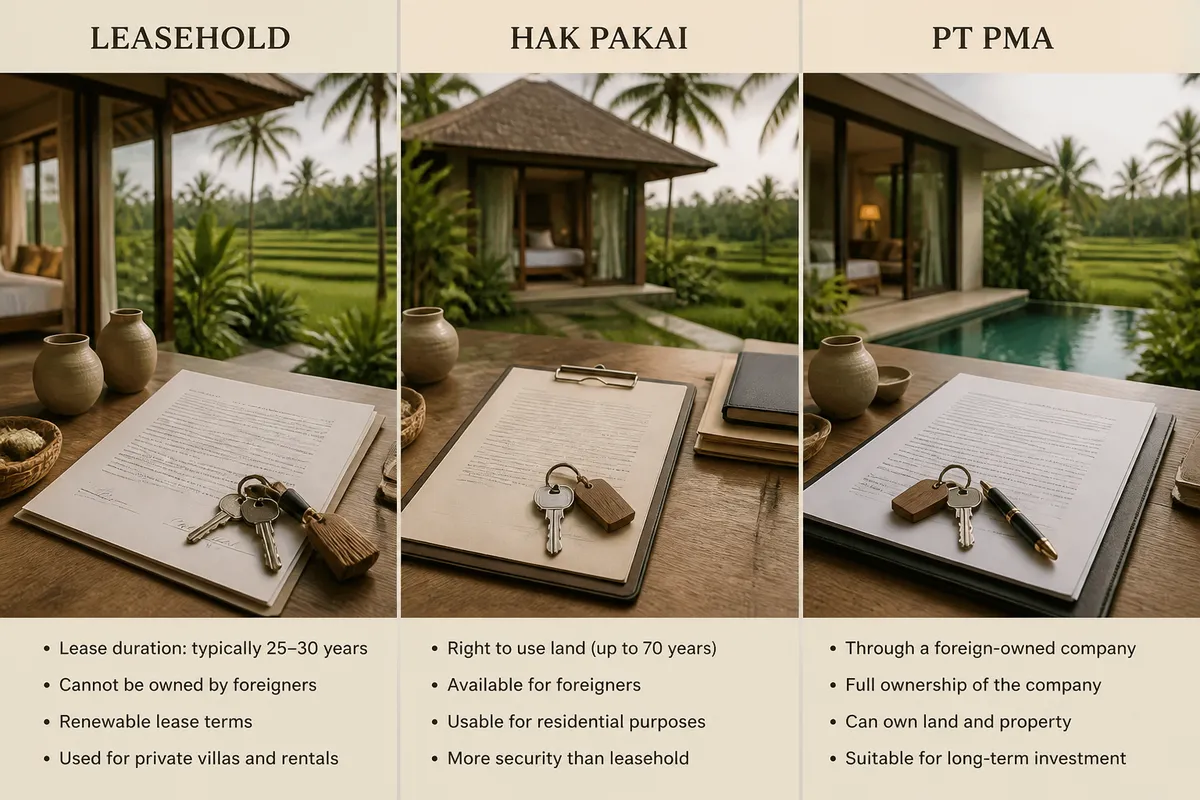
| Option | Who it's for | What you control | Key limits |
|---|---|---|---|
| Leasehold (Hak Sewa) | Personal or holiday use, shorter horizon | Full use of the villa and land for the agreed term | A contract-based right, not land ownership; a Bali lease runs usually 25–30 years, extendable up to 80, per Emerhub, January 2026 |
| Hak Pakai | A foreign resident wanting a registered title | A registered right to use certain residential property | Still a right to use, not freehold, per Expatica, August 2026 |
| PT PMA | Commercial rental and investors | The company owns the villa; you own the company | Ownership sits with the company and brings company obligations; Emerhub, January 2026 calls a PT PMA the only legal way for foreigners to own a villa in Bali |
 Enlarge image
Leasehold
Leasehold gives you use of the villa and land for a fixed, renewable term written into a notarised contract, as described by Expatica, August 2026, and that term usually starts at 25–30 years with an option to extend up to 80 per Emerhub, January 2026. Because everything hangs on the wording, read the extension and transfer clauses before you sign — not after.
Hak Pakai
Hak Pakai is a registered "right to use" title available to foreigners for certain residential property. It sits closer to a personal title than leasehold does, but it is still a right to use rather than freehold ownership, and eligibility depends on your residency status, so have a Notary and PPATA notary (notaris) certifies agreements, including a land lease. A PPAT (Pejabat Pembuat Akta Tanah) is an official authorised to draw up deeds on land rights. In Bali one person often holds both roles. confirm you qualify for the specific plot.
PT PMA
A PT PMA is an Indonesian foreign-owned company that holds the property; you control the villa by controlling the company. This is the route when you plan to rent commercially, because it is built for business use. It carries company obligations — reporting, accounting, licensing — so budget for the running cost of the entity, not just the villa.
Match the structure to the plan: choose leasehold for a personal or holiday villa, and a PT PMA when you will rent the villa out commercially. Compare the lease term, the renewal terms and whether commercial letting is allowed, then have a notary confirm the structure legally permits your intended use for as long as you need it. Rules differ by zone and change over time, so a structure that fits today still deserves a fresh check before you commit.
How to buy a villa in Bali: step by step
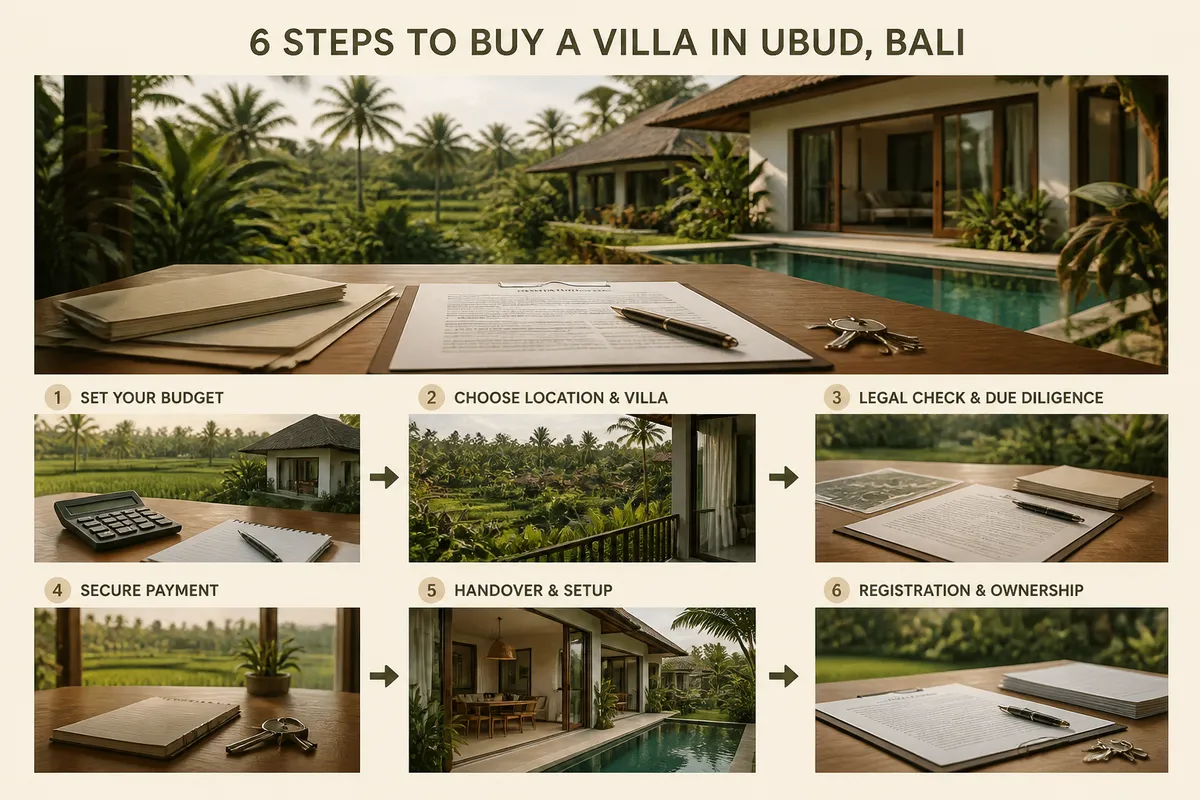
Buy in a set order — define your budget and area, shortlist villas, run legal Legal due diligenceAn independent lawyer’s check before purchase: who holds the land, its zoning and permits, and whether there are mortgages, seizures or court disputes., sign a notarised sale or lease agreement, pay in stages, then register the right — and never move money to the next stage until the previous one is signed off. The sequence below keeps your cash behind each cleared checkpoint.
- Set your budget and target area. Decide your spending ceiling and whether the villa is for living, renting or both, then shortlist areas that fit. You know this step is done when you have a written budget that already allows for fees and taxes, not just the villa price.
- Shortlist villas and request details. Gather candidates and ask each seller for documents and a written price breakdown. Drop any villa where the paperwork is vague — that is your first filter.
- Run legal due diligence. Verify the certificate, zoning, permits and the seller's legal entity (see the checklist below). Treat an unverifiable document as a "no," not a "later."
- Engage a notary and sign the agreement. Use a licensed Indonesian notary (notaris/PPAT) to draft and verify the sale or lease agreement before any payment, and have them confirm the seller's title and the contract terms in writing. A notary checks documents and title — not the physical build quality — so keep a separate eye on the construction itself.
- Pay in stages. Release funds against signed milestones rather than up front. If a seller wants full payment before the paperwork clears, stop.
- Register the right. Record the lease, Hak Pakai or company ownership so your control is documented, not just promised. Timelines vary by seller and permit status, and off-plan deals run on a construction schedule, so confirm dates in writing.
When the six steps are done, your deal file should look like this sample — if any line is empty, the purchase is not finished:
| Step | What you hold when it is done |
|---|---|
| Budget and area | A written budget that lists the villa price, notary fees, taxes, due diligence and furnishing, plus a short list of areas that fit your use |
| Shortlist | For each candidate villa, the seller's document list and a written price breakdown |
| Due diligence | Copies of the land certificate, zoning and KKPRKesesuaian Kegiatan Pemanfaatan Ruang: confirmation that the planned use of a plot matches the spatial plan, in other words the zoning check. CITRINE: KKPR issued on 22.05.2026., the building permit (PBGPersetujuan Bangunan Gedung, the Indonesian building approval that replaced the IMB in 2021. It confirms that the design meets technical standards. CITRINE: PBG No. SK-PBG-510405-06082026-006 of 06.08.2026./IMB) and the SLF, each confirmed by the notary against the actual plot |
| Notary and agreement | A sale or lease agreement drafted or verified by a licensed notary (notaris/PPAT) and signed by both sides |
| Staged payments | A receipt for every payment, each matched to a signed milestone |
| Registration | The registered lease, Hak Pakai certificate or company ownership record that names you or your company |
 Enlarge image
Where to buy: choosing a location
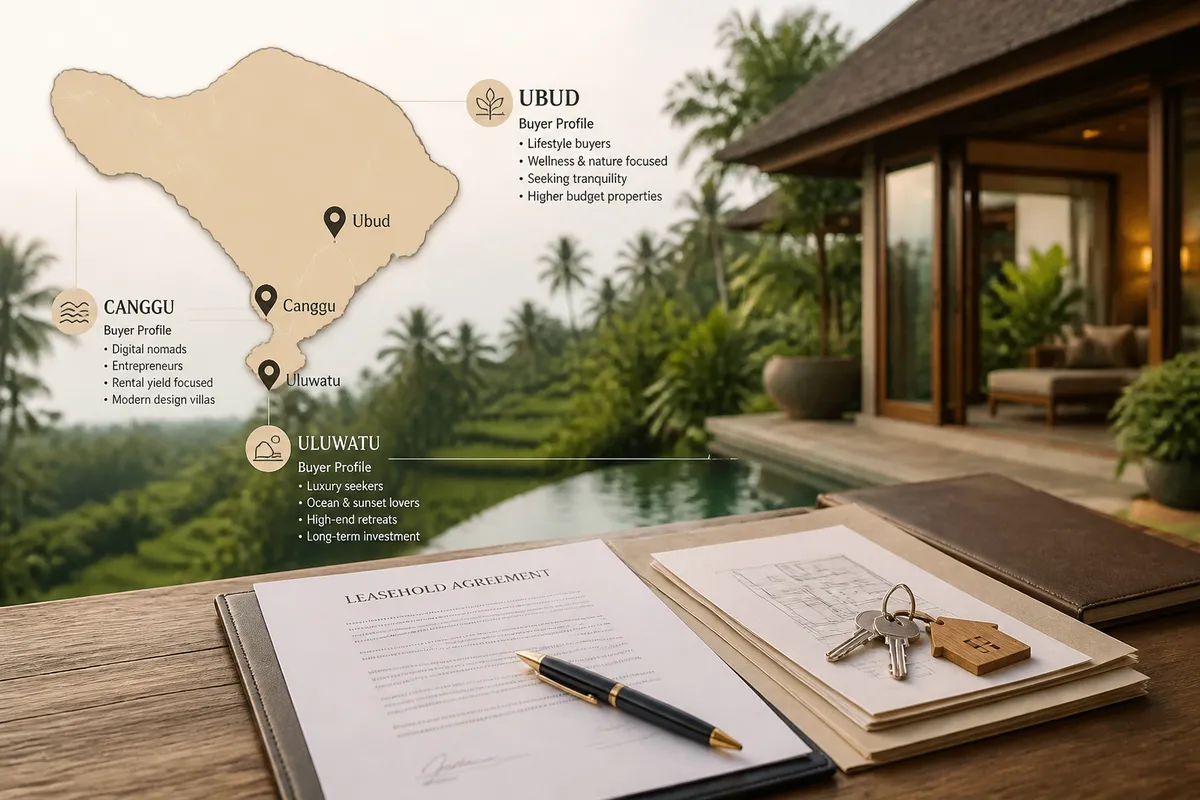
Match the area to your goal: rental-focused buyers look at high-demand zones, while lifestyle buyers lean toward quieter inland areas such as Ubud. Start by listing your priorities — rental demand, quiet, beach or town access — and shortlist areas against them before you view a single villa.
Canggu and Uluwatu draw short-stay guests and suit buyers chasing OccupancyThe share of nights a villa is booked over a period. Green Harmony: 88.1% on average, January–July 2025. Past results, not a forecast.; Ubud, inland and green, tends to attract longer stays and buyers who want to use the villa themselves. The test is simple: does the shortlisted area support your main use case and the occupancy you are counting on? Area demand and zoning both shift, so check the current rental rules for each zone rather than trusting an older guide — a street that allows short-term letting on one side may not on the other.
 Enlarge image
Budget, taxes and ongoing costs
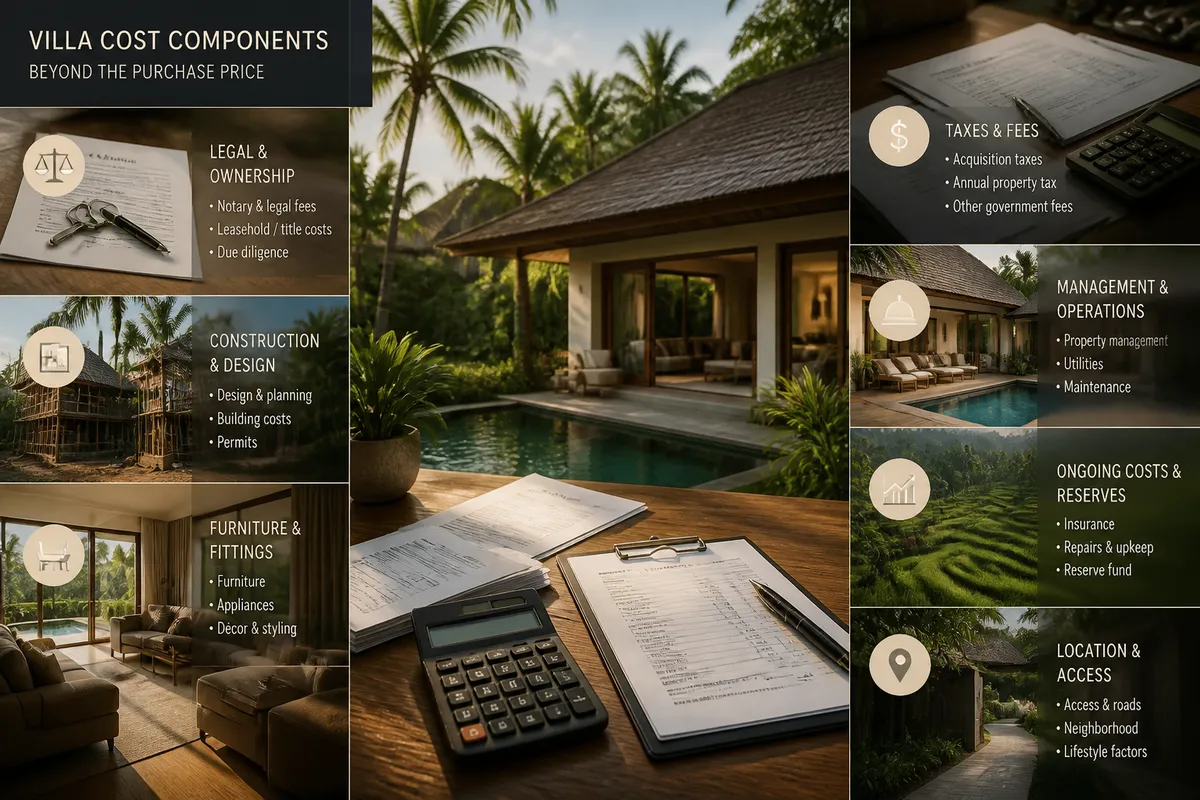
Budget well beyond the villa price — for notary fees, taxes, due diligence, furnishing and ongoing management. Build a cost list that itemises every fee and tax on top of the purchase so your budget covers all the one-off and recurring items, not only the headline figure.
| Cost item | Who charges it | Notes |
|---|---|---|
| Villa price | Seller / developer | Not published here — ask the sales manager for the current price and a written total before you commit |
| Notary / PPAT fees | Notary (notaris/PPAT) | Drafting and verifying the agreement and registering the right |
| Purchase and transfer taxes | Government | Depend on the structure and value; confirm the current rate with your notary |
| Due diligence and legal checks | Your lawyer or agent | Certificate, zoning, permit and seller verification before you pay |
| Furnishing and setup | Suppliers | A one-off cost to make the villa rentable or liveable |
| Property management | Management companyThe company that runs a villa as a rental after handover: bookings, guests, cleaning, maintenance and the monthly owner report. It is paid a share of revenue. | An ongoing fee on rental revenue if you let the villa |
Ask the seller's sales manager for the current villa price and the total cost in writing before committing, because quoted prices move with exchange rates and availability. Fee amounts also depend on the deal structure and the property, so treat any estimate as a starting point and get your own numbers confirmed.
 Enlarge image
Due diligence: documents and permits to verify
Before you pay, verify the land certificate and ownership history, the zoning and KKPR, the building permit (PBG/IMB) and the SLF, plus the seller's legal entity. Obtain each document from the seller and have a notary confirm it is valid and matches the actual property.
- Land certificate and ownership history. Confirm the title is genuine and traces cleanly to the current seller. The check is complete only when the names and the plot match across every document.
- Zoning and KKPR. Make sure the plot is zoned for a villa and for your intended use; a residential zone will not support commercial letting.
- Building permit (PBG/IMB). Do not buy an existing villa that lacks an official building permit such as IMB or PBG/PGB — confirm a current, matching permit is on file before you make any offer.
- SLF (certificate of worthiness). Verify the building is certified fit for occupation.
- Seller's legal entity. Check who legally owns and is entitled to sell, and that they can sign.
Document checks are powerful but not total: they cannot reveal an undisclosed verbal arrangement, and permit rules vary by zone and get updated. When a seller cannot produce a document, treat the gap as the finding — not an inconvenience to work around.
 Enlarge image
Off-plan vs ready villa, and choosing a developer or agent
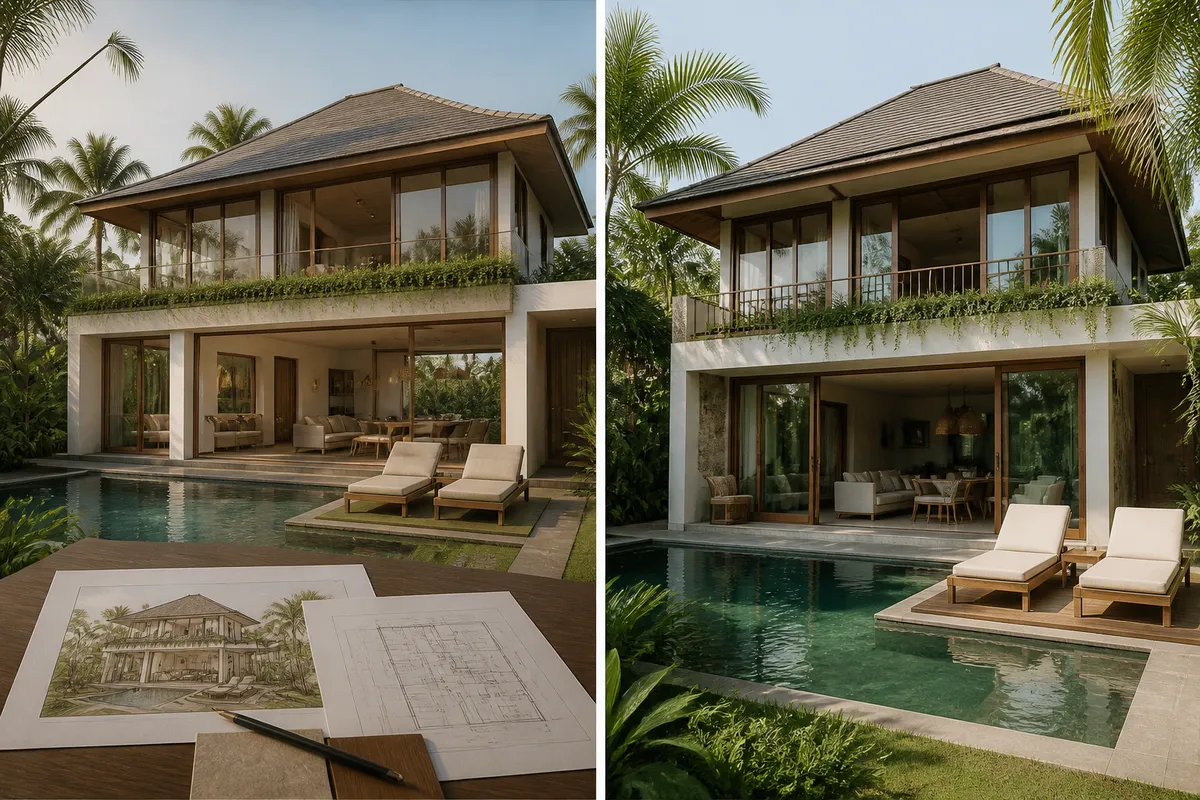
The trade-off is simple: an off-plan villa lets you pay by construction stage and often buy newer design, while a ready villa lets you inspect the finished build before you commit. Weigh staged payments and a fresh layout against the certainty of walking through completed rooms, then pick the option that matches your risk tolerance and timeline.
Off-plan leans on the developer delivering on schedule, so vetting matters more than the render. Ask to see completed, handed-over projects — not just visualisations — and check whether payments are tied to verified construction milestones. For a ready villa, bring in your own inspector alongside the notary, since the notary confirms the paperwork, not the roof. Imagine two buyers with the same budget: one wants to lock in a lower stage-payment plan and can wait a year, the other wants to collect rent next month — they should not choose the same villa. The buyer who can wait is better off with an off-plan project, vetting the developer's delivery record and tying payments to milestones; the buyer who needs income now should shortlist a ready, handed-over villa that can be inspected and listed straight away. Let the timeline you can actually live with decide which type you pursue.
 Enlarge image
Rental income, permits and property management
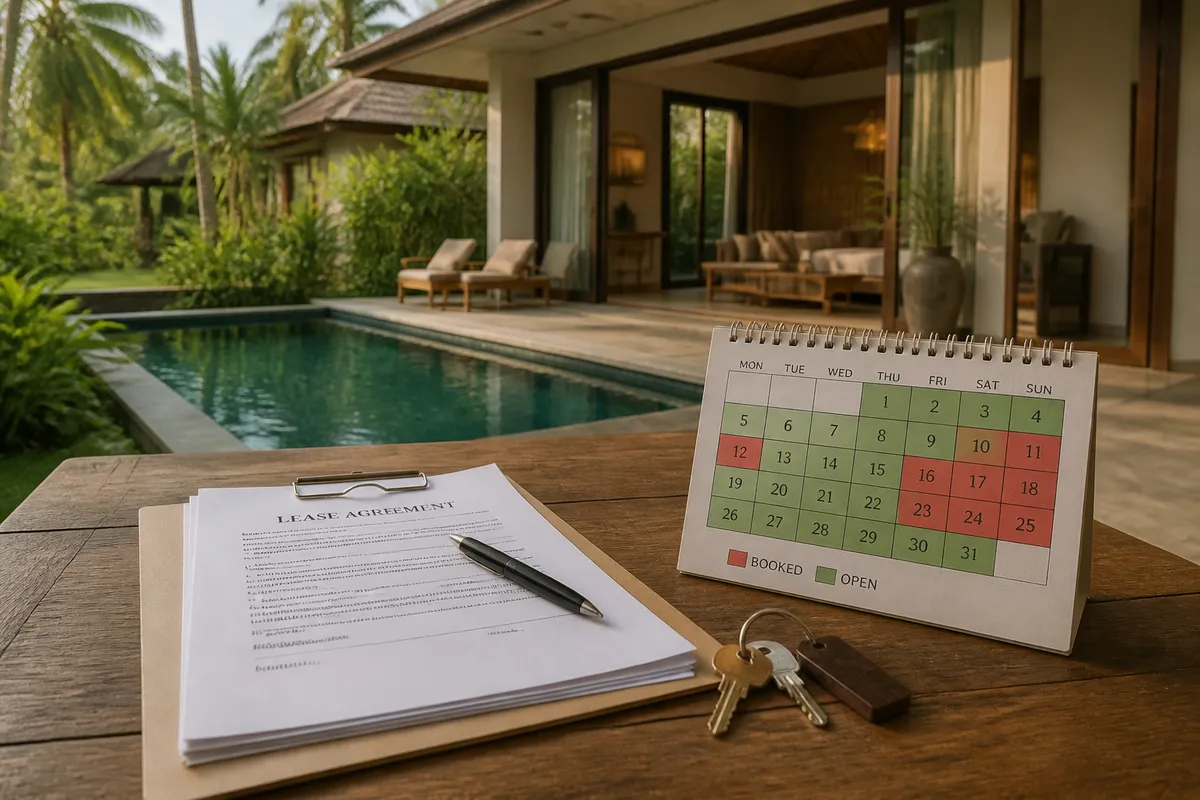
Rental income in Bali is real but conditional: it only starts once the villa is built, correctly permitted and actually operating, and you keep what is left after management and running costs. Before you count on a single booking, confirm the villa holds the correct rental (pondok wisata) permit for its zone — a current permit covering short-term letting is the line between legal income and a problem, and that permission depends on zoning that can change.
Letting a villa means handling listings, guests, cleaning, maintenance and payouts, which is why most remote owners hand it to a management company for a share of revenue.
Here is a sample yield calculation on assumed figures — none of these are quoted prices:
- Assume a nightly rate of $150, 70% occupancy, and a management-and-marketing share of 20% of revenue (all assumptions).
- Nights let: 365 × 70% = 256 nights
- Gross revenue: 256 × $150 = $38,400 per year
- Management share: $38,400 × 20% = $7,680
- Net rental income before taxes and other running costs: gross revenue minus the management share
To turn that into a yield percentage you would divide net income by the price you paid — which is exactly why you ask the sales manager for the current villa price rather than guessing it. Change the occupancy or nightly rate and the result moves fast, so run the numbers on conservative assumptions, not best-case ones.
 Enlarge image
Buying as an Australian and 2026 rule updates
Australians can legally buy property in Bali, but Indonesian legislation restricts the form of ownership available to foreigners, according to Expatica, August 2026 and Emerhub, January 2026. In practice that means the same routes as any other foreign buyer — leasehold, Hak Pakai or a PT PMA — rather than freehold in your own name.
Because permit and zoning rules change, check the latest 2026 regulations with a notary before you proceed, so your plan rests on rules confirmed as current rather than an older article — including this one. Rules can shift again after you check, which is another reason to keep the notary involved right up to signing rather than only at the start.
Common mistakes foreign buyers make
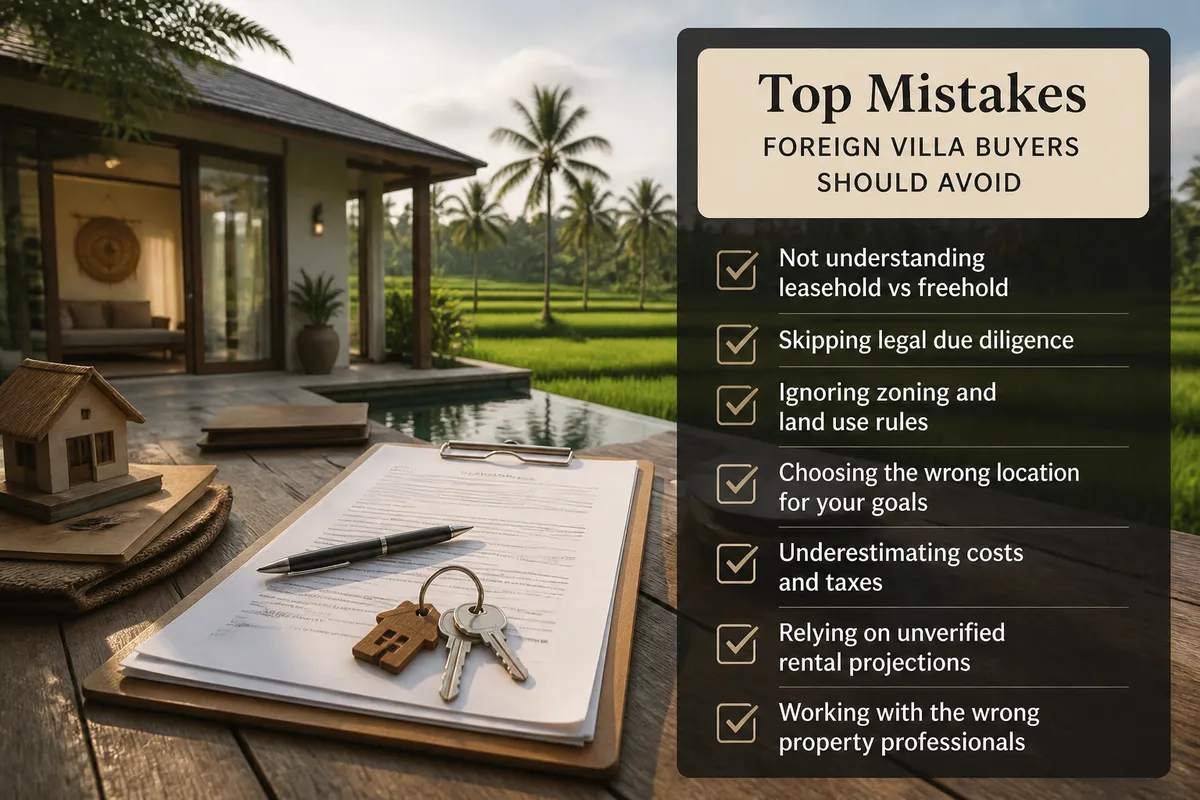
The costly mistakes cluster around three habits: skipping permit checks, paying before due diligence is finished, and relying on verbal promises. Insist on documented permits, completed due diligence and written terms before any money moves.
- Skipping permit and certificate checks. Buying on trust and discovering a missing IMB/PBG or SLF later. Confirm every permit first.
- Paying before due diligence is complete. Releasing a deposit to "hold" a villa before the title clears. Keep cash behind each signed milestone.
- Relying on verbal promises. Treating a WhatsApp assurance as a contract. If it is not in the signed agreement, it does not exist.
- Assuming freehold. Expecting to own the land outright and only learning about leasehold at signing.
- Ignoring zoning. Counting on rental income in a zone that does not allow short-term letting.
Thoroughness lowers your risk sharply, but it does not remove market risk, so keep some headroom in your budget rather than stretching to the last dollar.
 Enlarge image
Our experience: delivered villa projects in Ubud
In our own practice, KAMRITA delivered the Green Harmony project in Ubud — four one-bedroom villas sold from renders in 2023 and handed over in October 2024, all four sold. That is the difference between a listing page and a developer: a completed, occupied project you can point to.
Those handed-over villas now hold a 9.0 "Superb" score from 12 guest reviews on Booking.com as of October 2026. Two guests left 10/10 reviews in 2026, singling out the ricefield view, the cleanliness, the privacy and the pool. We keep guest names private, but the scores and the project itself are public.
If you want a fast answer while you compare options remotely, our sales manager replies within 15 minutes on WhatsApp and Telegram during Bali hours, GMT+8. Use that to pressure-test any villa you are weighing — including ours — against the checklist in this guide.
 Enlarge image
Frequently asked questions
How long does buying take, and what about taxes and getting rental income out? These depend on the structure you choose and your own tax residency, so there is no single figure. Agree the expected timeline in writing before you pay, and confirm the tax treatment and any rules on moving rental income abroad with a licensed notary and a tax adviser before you sign. Engage the notary (notaris/PPAT) before any payment, and never release money for the next stage until the current one is signed off. Treat any missing or unverifiable document as a reason to stop.
Can I buy a villa in Bali? Yes — just not as freehold land in your own name, which is reserved for Indonesian citizens, per Expatica, August 2026. See the ownership options above to match a route to whether you want the villa for yourself or to rent out.
Do I need a visa or to live in Indonesia to buy a villa? Not necessarily — the route that fits depends on your situation more than on a single permission. Whether you are buying for your own stays or to rent out, and whether you hold residency, affects which instrument you can use, so confirm your eligibility for a specific plot with a licensed notary before you commit.
The bottom line
Buying a villa in Bali as a foreigner is less about "can I own land" and more about choosing the right instrument — leasehold, Hak Pakai or a PT PMA — then working through the deal in order, verifying every permit, and keeping your cash behind each signed milestone. Do that, confirm the current 2026 rules with a notary, and run your rental numbers on conservative assumptions, and you move from guessing to deciding.
If you want to walk the routes against your own situation and see what a completed, guest-rated villa in Ubud actually looks like, the KAMRITA team can talk it through with you — no pressure, just the paperwork and the real numbers.
Next step
We build villas in Ubud and write about what we check on our own projects: land, permits, construction and the numbers of completed villas. About the team