
PT PMA in Bali: Buying Property as a Foreigner
Can a foreigner buy a villa in Bali? See how a PT PMA and leasehold work, the legal steps, taxes and fees, and real rental results from a delivered Ubud project.
 KAMRITA team12 min read ·
 Enlarge image
Contents11 sections
- What is a PT PMA in Bali?
- Can a foreigner buy a villa in Bali?
- Leasehold vs PT PMA vs Hak Pakai — which to choose
- How to set up a PT PMA: step by step
- Buying an off-plan villa step by step: how we de-risk it
- Taxes, fees and ongoing costs
- Rental income and property management
- Risks and common mistakes to avoid
- Frequently Asked Questions
- The takeaway
- Next step
Yes — a foreigner can legally buy and use a villa in Bali, just not as Freehold (Hak Milik)Full ownership of land. Under Indonesian law it is available only to Indonesian citizens, so foreign buyers in Bali work with leasehold.. Indonesia keeps full land ownership (Hak Milik) for its citizens, so non-citizens use one of three legal routes instead: a lease (Leasehold (Hak Sewa)A long-term lease of land, signed before a notary. The land itself is not bought. For CITRINE the land lease runs from 28.11.2025 to 28.11.2055, with a right to extend for 30 years at the market price of land.), the right to use (Hak Pakai), or company ownership through a PT PMAPerseroan Terbatas Penanaman Modal Asing: an Indonesian limited company with foreign shareholders. KAMRITA works as PT KAMRITA REAL ESTATE INVESTMENTS, a PT PMA. holding Hak Guna Bangunan (HGB). This guide explains each route, the setup steps, the running costs, and the mistakes that cost foreign buyers money — with evidence from a villa project that was actually built and handed over in Ubud, not just promised.
What is a PT PMA in Bali?
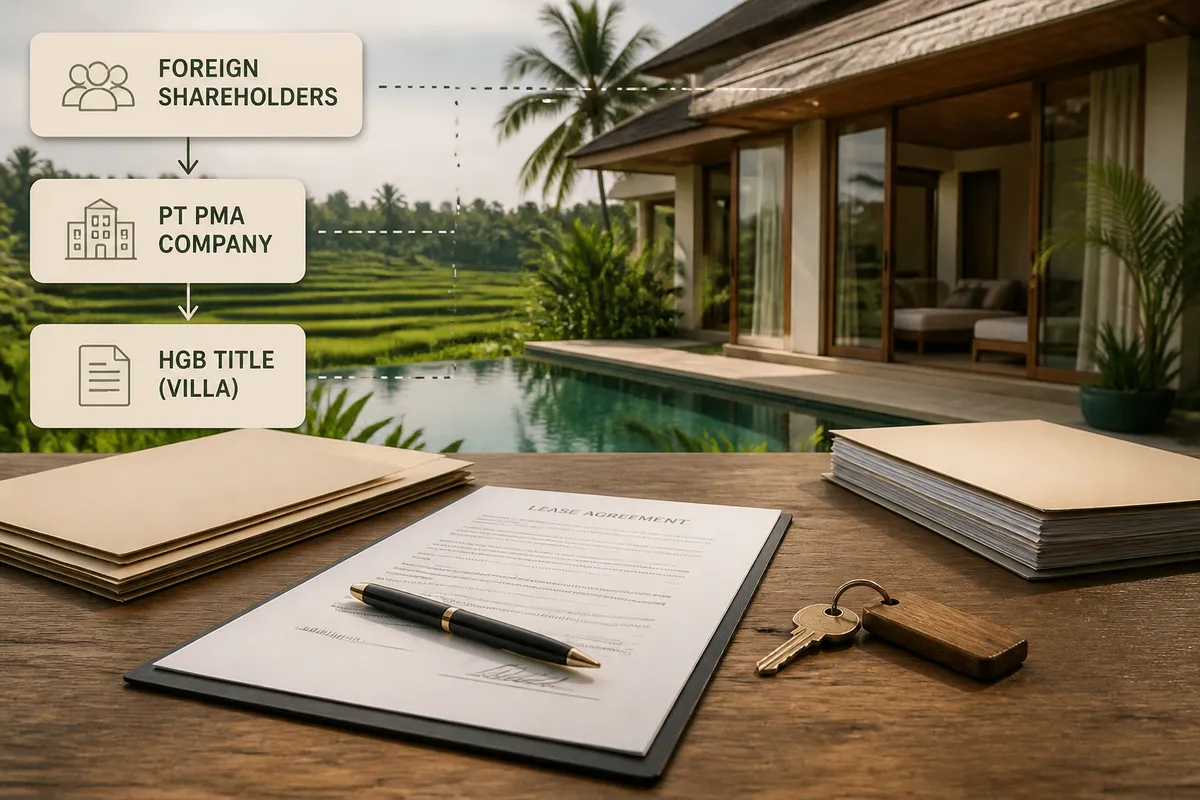
A PT PMA (Penanaman Modal Asing) is a foreign-owned Indonesian limited liability company that lets non-citizens legally run a business — and, through that company, hold property. For a villa buyer it turns "a foreigner can't own land here" into "my company holds a registered building title," which is the part that makes rental income and resale cleaner.
You need one when you want direct, company-held title and the ability to run a licensed short-stay rental at scale, rather than a single personal lease. According to Emerhub — how to buy a villa in Bali as a foreigner, January 2026, a foreign-owned company (PT PMA) is the only legal way for a foreigner to own a villa in Bali — "own" here meaning hold title to the property, as opposed to the use-rights a lease (Hak Sewa) or Hak Pakai give you without land ownership. If your plan is simply to use a villa yourself for a fixed period, a lease may be enough and a company is overkill.
 Enlarge image
Can a foreigner buy a villa in Bali?
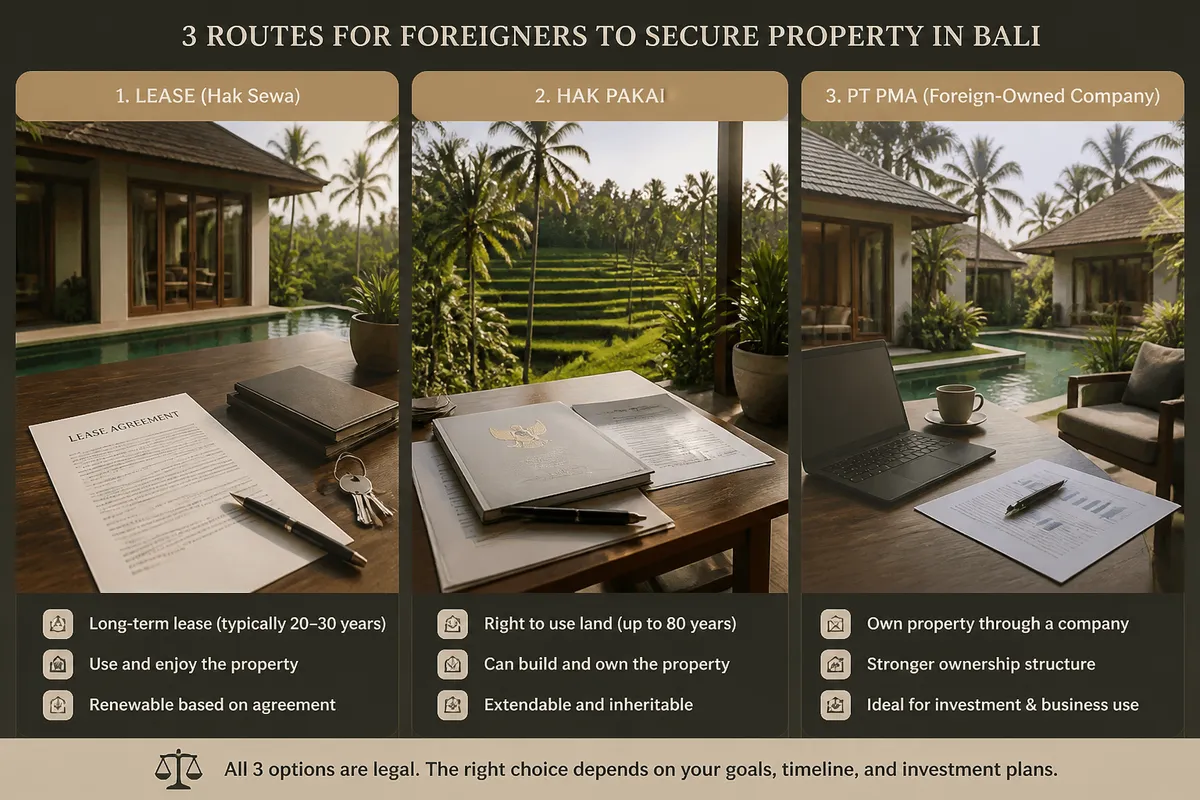
Yes. Foreigners cannot hold freehold (Hak Milik) land in Indonesia, but they can secure a villa through a lease (Hak Sewa), the right to use (Hak Pakai), or company ownership via a PT PMA holding Hak Guna Bangunan (HGB). According to Expatica — foreign property ownership rules in Indonesia, August 2026, foreign buyers use leasehold (Hak Sewa) — a contract-based right rather than land ownership — or Hak Pakai, a registered right to use.
Here is what each route gives you:
- Lease (Hak Sewa). You buy the right to use the land and villa for a fixed, renewable term. You never own the land; the arrangement lives in your contract.
- Hak Pakai. A right-to-use title registered to a qualifying foreigner over certain residential property. It is a registered right, not a contract sitting in a drawer.
- PT PMA with HGB. Your company holds the building-rights title. This is the route that supports operating a rental business under your own control.
 Enlarge image
Leasehold vs PT PMA vs Hak Pakai — which to choose
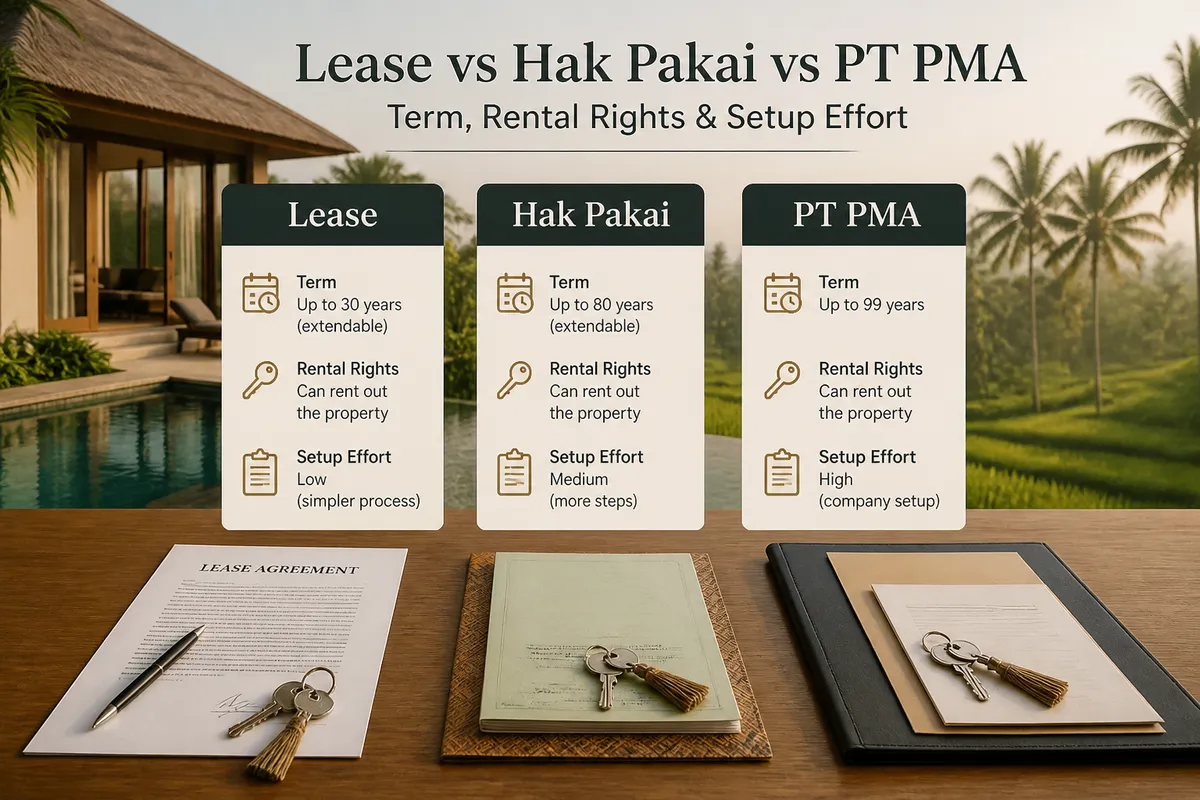
Choose by what you actually want from the villa. If you mainly want to use it yourself for a set period, a lease is the lightest option. If you want a registered personal right to use residential property, Hak Pakai fits. If you want company-held title and a rental business you control, a PT PMA holding HGB is the structure built for that.
Put plainly: start from your goal, then pick the lightest structure that delivers it. Use-only for a fixed period points to a lease; a registered personal right to live in residential property points to Hak Pakai; a rental business you own and control points to a PT PMA with HGB. Say you want to spend a few seasons a year in a villa with no plan to rent it out — a lease covers that, and setting up a company would only add cost you don't need.
| Route | Who can hold it | Term | Rental rights | Setup effort | Best for |
|---|---|---|---|---|---|
| Lease (Hak Sewa) | Any foreigner, personally | Fixed, renewable term set in the contract — a contract-based right to use, not ownership, per Expatica | Limited; depends entirely on contract terms | Low | Personal use for a defined period |
| Hak Pakai | A qualifying foreign resident | Registered right to use, renewable | Possible, within the title's scope | Medium | A registered personal home |
| PT PMA + HGB | A foreign-owned company | Company-held building title, renewable | Full, run as a licensed business | High | Rental income and resale at scale |
A lease is cheaper and faster to enter but gives you the least control and a right that ends when the term ends. A PT PMA costs more to set up and maintain but puts a registered title in a structure you own. The practical dividing line: one villa for yourself leans lease or Hak Pakai; a rental operation leans PT PMA.
 Enlarge image
How to set up a PT PMA: step by step
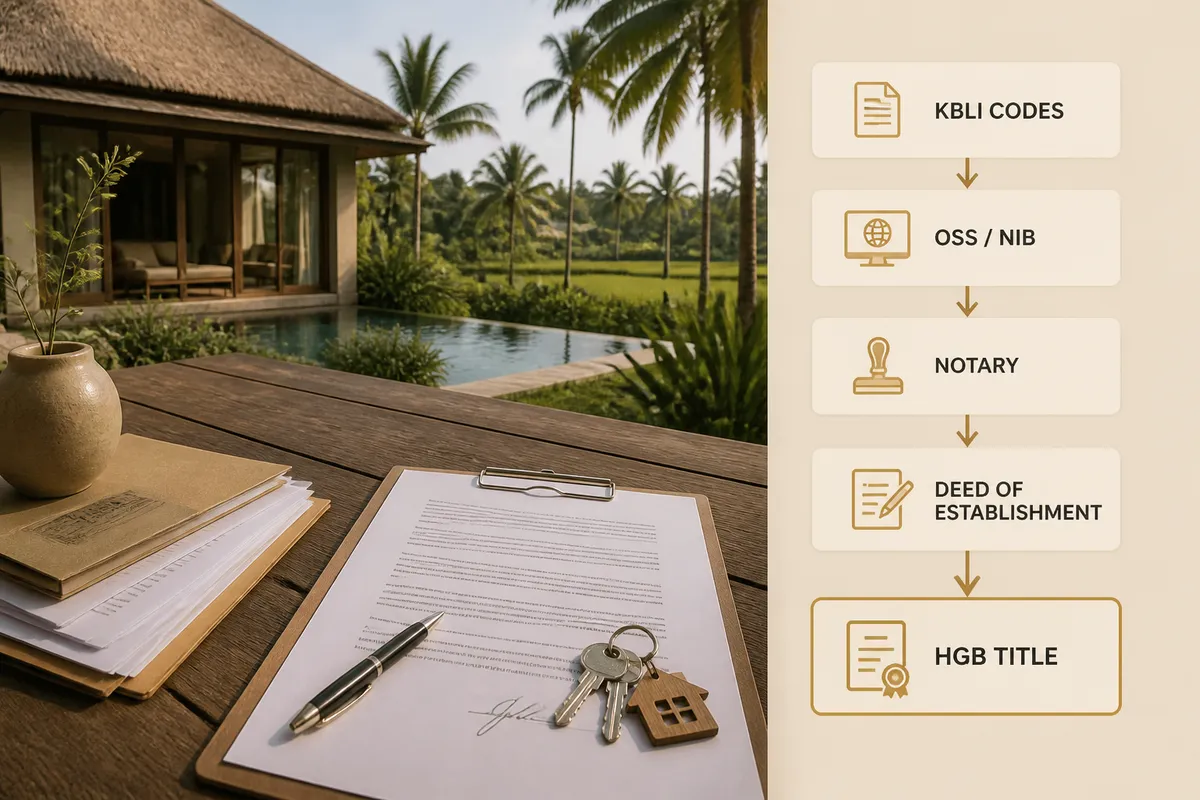
Setting up a PT PMA means registering a foreign-owned company, getting its licences, and putting the villa title in the company's name — all before any purchase money moves. Register through BKPM/OSS and appoint a licensed Notary and PPATA notary (notaris) certifies agreements, including a land lease. A PPAT (Pejabat Pembuat Akta Tanah) is an official authorised to draw up deeds on land rights. In Bali one person often holds both roles. (PPAT) first; paying before the company and title exist is where buyers lose leverage.
- Set the shareholder and capital structure. Decide who the foreign shareholders are and how the company is capitalised.
- Choose the business codes (KBLI). Pick codes that match property and rental activity, so your licence actually covers what you plan to do.
- Register via BKPM/OSS and obtain the NIB. The OSS system issues the business identification number (NIB) that proves the company legally exists.
- Appoint a licensed notary (PPAT). The notary handles the deed work and the title transfer; use a licensed one, not an informal intermediary.
- Open the company bank account. Funds for the purchase flow through the company, not a personal account.
- Register the title as HGB in the company's name. Confirm the Hak Guna Bangunan title is recorded to the company before you treat the deal as done.
You know this stage succeeded when the company holds a valid NIB and the HGB title is registered in its name. If you are doing a pure lease deal instead, you skip all of this — no company is required.
 Enlarge image
Buying an off-plan villa step by step: how we de-risk it
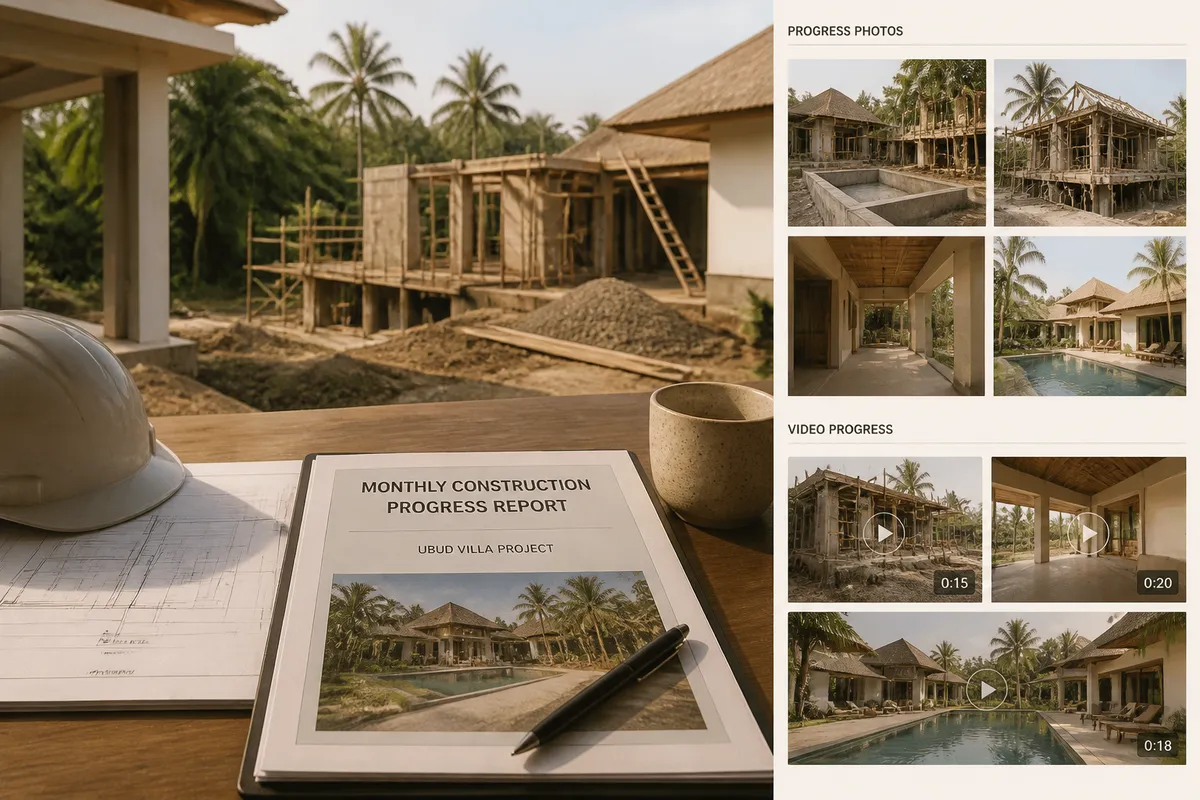
Buying off-plan remotely is safest when you verify the developer's delivered projects, lock the legal structure and title before paying, and release money against construction progress you can actually check. A documented, handed-over building tells you more than any render — it shows the team finishes what it sells.
- Verify the track record first. Ask for projects that are built and occupied, not only in marketing. Kamrita's Green Harmony project in Pejeng, Ubud — four one-bedroom villas with a study — sold out four of four off renders in 2023 and was delivered in October 2024.
- Lock the legal route before money moves. Decide lease vs PT PMA, and have the structure and title path set before the first payment.
- Run the document checks. Certificate, zoning and permit — covered in the risks section below.
- Tie payments to verified construction stages. Releasing funds against milestones you can confirm, rather than a lump sum upfront, keeps your money matched to real progress.
- Require regular progress evidence. Photos and video of the site on a schedule let you supervise a build you can't walk through.
- Plan handover and management early. Agree who takes over operations the day the villa is finished, and pin down three things in writing: the scope of what the manager handles, how their fee is calculated, and a handover inspection to sign off the finished villa against what was promised. You'll know it's settled when those terms are agreed before handover, not left to negotiate after you've moved in.
Remote buyers also judge a developer by how fast questions get answered. Kamrita's sales manager replies on WhatsApp and Telegram within 15 minutes, Bali time (GMT+8).
 Enlarge image
 Enlarge image
Taxes, fees and ongoing costs
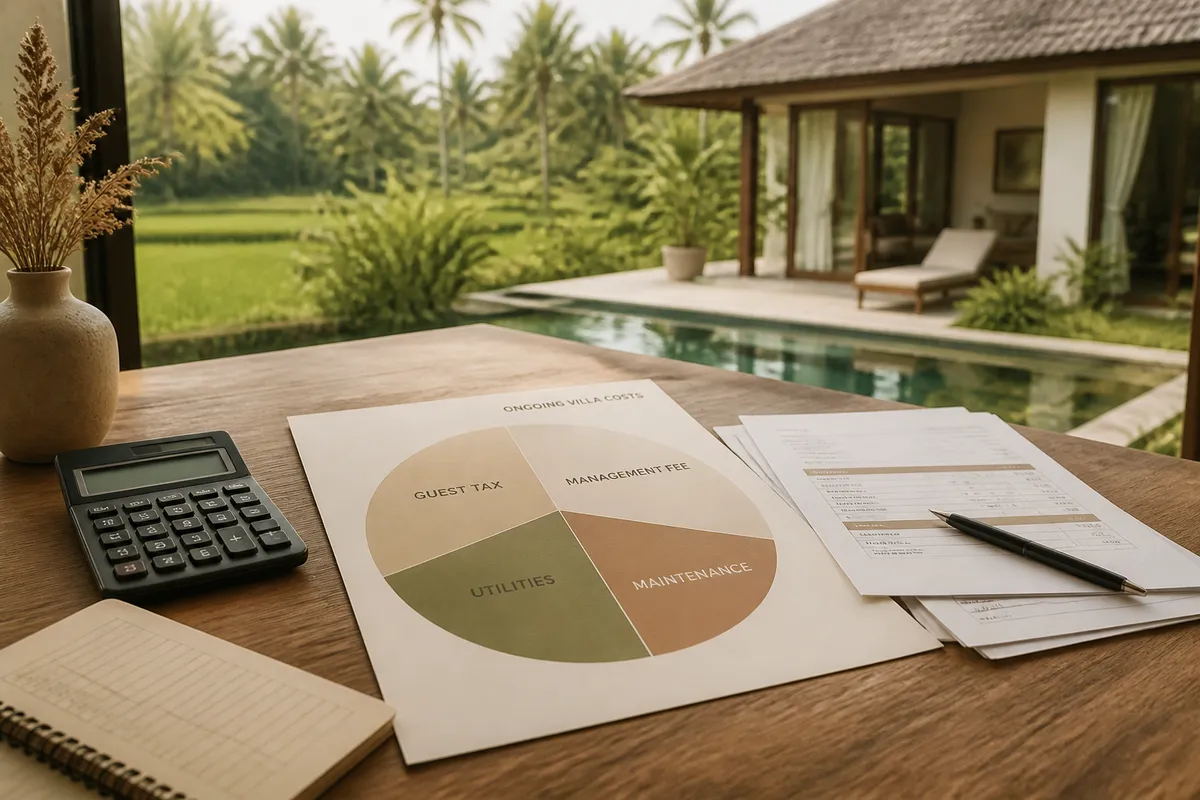
Owning and renting a Bali villa carries one-off costs at purchase and recurring costs while you hold it. The one-offs are notary and legal work; the recurring ones are a tax on guest stays, a management fee taken from rental revenue, utilities and maintenance. None of these are the villa price, and the exact rates should be confirmed with your manager rather than assumed.
| Cost | What it is | When you pay |
|---|---|---|
| Guest/tourist tax | A local tax applied to paying guest stays | Per booking, while renting |
| Management fee | A share of rental revenue paid to the company that runs the villa | Monthly, while renting |
| Notary / legal | Deed, registration and company paperwork | Once, at purchase |
| Utilities | Electricity, water, internet | Ongoing |
| Maintenance | Pool, garden, repairs, cleaning between guests | Ongoing |
To see how the pieces fit, work an example on placeholder numbers — not Bali's real rates, which you should confirm.
Sample calculation: assume gross annual rental revenue is $24,000; assume a management fee of 20% and a guest tax of 10%.
- Management fee: $24,000 × 20% = $4,800 per year
- Guest tax: $24,000 × 10% = $2,400 per year
- Revenue left before utilities and maintenance: $24,000 − $4,800 − $2,400 = $16,800 per year
Swap in the real rates and your own revenue assumption and the method stays the same. This kind of estimate breaks down if OccupancyThe share of nights a villa is booked over a period. Green Harmony: 88.1% on average, January–July 2025. Past results, not a forecast. is seasonal or your assumed revenue is optimistic — which is why documented results matter more than a tidy spreadsheet.
 Enlarge image
Rental income and property management
A villa earns rental income only once it is built and handed over, and day-to-day letting is usually run by a licensed Management companyThe company that runs a villa as a rental after handover: bookings, guests, cleaning, maintenance and the monthly owner report. It is paid a share of revenue. that handles bookings, guests and marketing. Before handover there is nothing to rent, so no rental income accrues until the building is finished and operating.
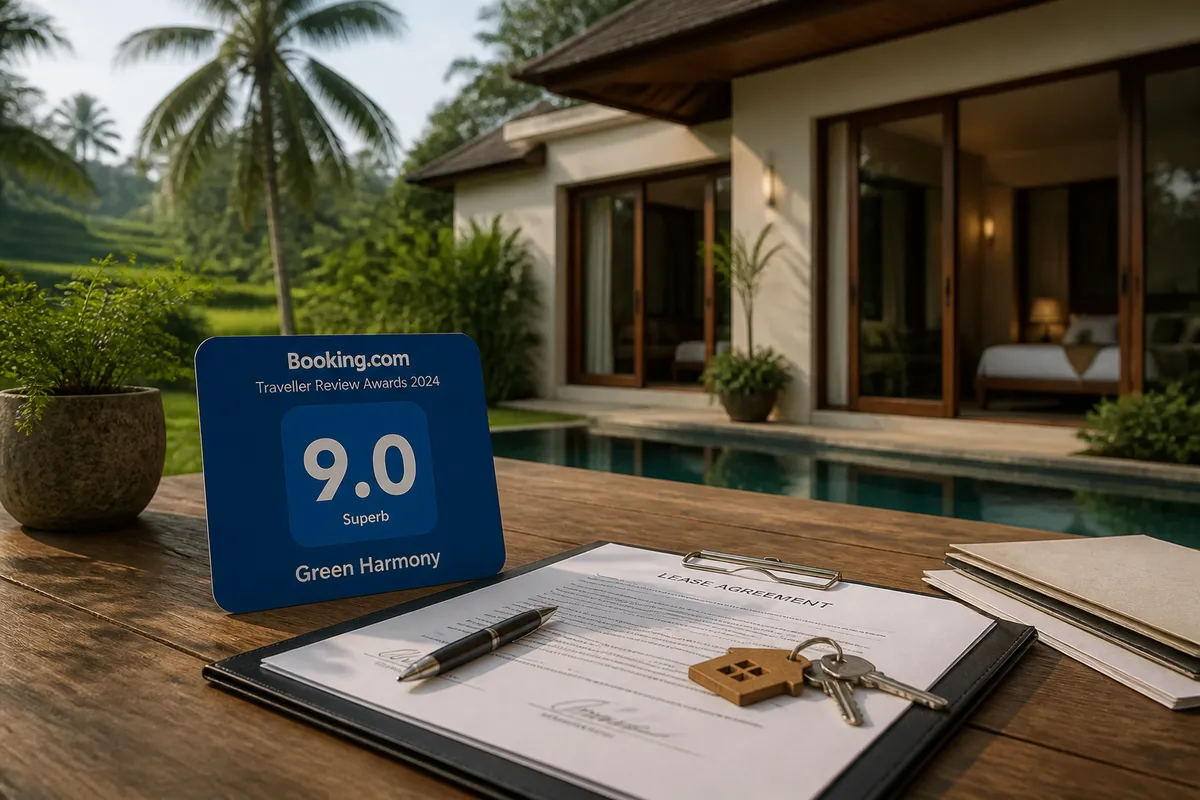
What realistic performance looks like is best read from a villa that is already running. Kamrita's delivered Green Harmony villa scores 9.0 "Superb" from 12 guest reviews on Booking.com as of October 2026, with top 10-out-of-10 reviews praising the rice-field view, cleanliness, privacy and the pool. That is guest sentiment from paying stays, not a projection.
When a developer shows you a forecast, ask what delivered project it is based on. If the answer is nothing finished and occupied, treat the number as marketing rather than evidence, and weigh the deal on the builds you can actually check.
If you want a sense of gross yield, keep it conditional. Gross yield is just annual rental revenue divided by the villa's value, expressed as a percentage — for instance, revenue equal to 8% of the villa's value over a year works out to an 8% gross yield. Treat that purely as arithmetic on assumed inputs; your real numbers depend on the specific villa, season and management.
 Enlarge image
 Enlarge image
Risks and common mistakes to avoid
Most foreign buyers lose money not on price but on skipped checks and the wrong structure. The four mistakes below are the ones that turn a villa into a dispute.
- Mistake: nominee ownership. Putting freehold title in a local person's name "on your behalf" feels simple and is legally unenforceable — if it goes wrong, the law does not back you. How to avoid it: buy only through a structure you legally control — a lease, Hak Pakai or a PT PMA — so your name or your company sits on the registered title. A side contract cannot make a nominee setup safe.
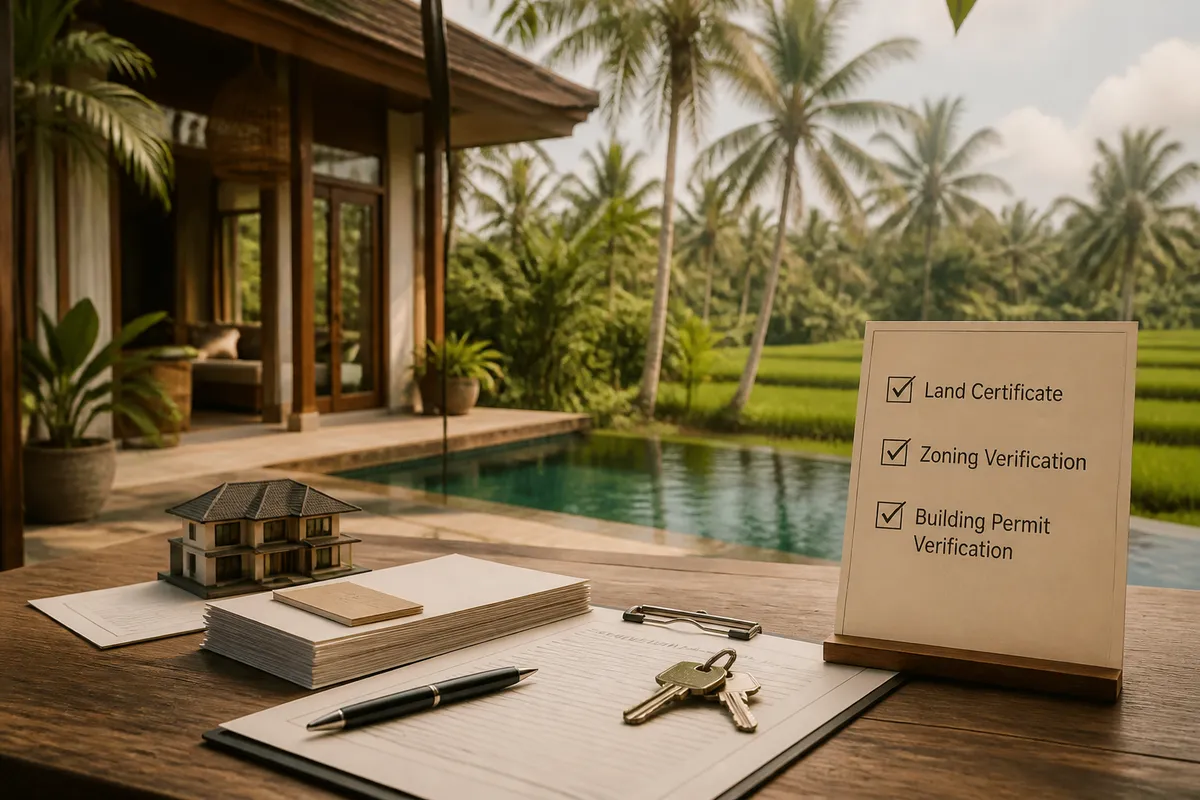
- Mistake: skipping document checks. Signing before you have verified the land certificate, the zoning (zona) and the building permit (PBGPersetujuan Bangunan Gedung, the Indonesian building approval that replaced the IMB in 2021. It confirms that the design meets technical standards. CITRINE: PBG No. SK-PBG-510405-06082026-006 of 06.08.2026./IMB) means you don't actually know what you're buying. How to avoid it: order a certificate and zoning check from an independent notary before signing, and confirm the certificate type, owner, zoning and permit all match the listing. Checks can't rescue an already-encumbered or protected-zone plot — but they tell you to walk away before you pay.
- Mistake: paying before the company and title are registered. Money sent ahead of a registered structure is money without leverage. How to avoid it: release funds only after the PT PMA (or lease) and title path are in place.
- Mistake: trusting projected yields over documented results. A forecast is a sales tool. How to avoid it: weight delivered, occupied projects and real guest ratings above any projection.
 Enlarge image
Frequently Asked Questions
How long does a Bali lease (Hak Sewa) run? According to Expatica — foreign property ownership rules in Indonesia, August 2026, leasehold (Hak Sewa) is a contract-based right to use a property for a set term rather than ownership of the land. The exact length and any renewal are fixed in the contract and vary by property, so confirm them for the specific villa before you commit.
What is a PT PMA and when do I need one? A PT PMA is a foreign-owned Indonesian company that can hold a villa's building title and run a licensed rental. You need one when you want company-held HGB title and a rental operation you control, rather than a single personal lease. For self-use only, a lease is often enough.
How long does a lease last? A lease runs for a fixed, renewable term that you and the owner set in the contract — it is a contract-based right to use the property, not ownership of the land. Because the term lives in the contract, read the renewal clause carefully before you sign.
Can I buy without flying to Bali? Yes. Remote purchases are routine when the legal structure is locked before payment, funds are released against verified construction stages, and you get regular photo and video evidence of progress. A developer with delivered, occupied projects and fast replies makes the remote process manageable.
Are nominee structures legal? No — nominee arrangements, where a local holds freehold title for you, are legally unenforceable, so you carry the risk with no protection. Use a lease, Hak Pakai or a PT PMA instead, so a registered title sits in your name or your company's.
What taxes apply when I rent it out? Renting a villa typically brings a tax on guest stays, a management fee taken from rental revenue, plus utilities and maintenance. Confirm the current rates with your manager rather than assuming them, and remember income starts only after handover.
The takeaway
A foreigner can own and rent a villa in Bali — through a lease, Hak Pakai or a PT PMA with HGB — as long as the structure is set before any money moves and the documents are checked by an independent notary. Pick the route by your goal: lease for personal use, PT PMA for a rental business you control. And weigh what a developer has actually delivered and how its villas are rated over any projected return.
If you'd like to match your situation to the right route and see a project that's already built, handed over and reviewed by real guests, Kamrita's team works on the ground in Ubud and can walk you through it — no price pressure, just the documents and the process.
Next step
We build villas in Ubud and write about what we check on our own projects: land, permits, construction and the numbers of completed villas. About the team